

That tomato has mould. Can you still cook with it?
Tomatoes are among the most perishable foods in Nigerian kitchens, and when one develops mould, the temptation to cut away the affected part can be strong. But food safety guidance says a mouldy tomato should be discarded rather than rescued.

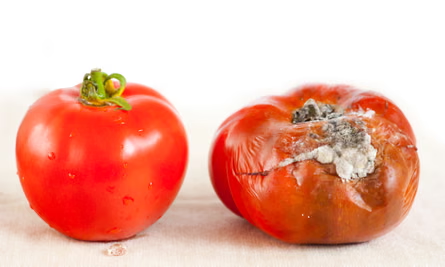
Nigeria has a complicated relationship with tomatoes. They are essential to the way many households cook, yet they can become unusable surprisingly quickly. A few tomatoes bought from the market can look perfectly healthy and begin to soften, leak or develop mould within days.
For households trying to manage food costs, throwing one away is not always an easy decision. You may deliberately choose softer tomatoes because they are cheaper and you plan to cook them immediately. Even when a tomato bought at full price develops a small patch of mould, the instinct is often to cut around it rather than waste the rest.
That instinct is understandable, but it is not the safest approach.
The United States Department of Agriculture classifies tomatoes among soft, high-moisture fruits and vegetables that should be discarded when mouldy. Unlike firm produce, where a consumer may sometimes cut away mould and part of the surrounding food, mould can penetrate deeper into soft foods such as tomatoes.
Nigeria’s tomato losses also put the issue into a wider context. Studies have reported substantial post-harvest losses at different stages of the tomato supply chain, although estimates vary according to location and methodology. Poor storage, high temperatures, rough handling and inadequate transportation all contribute to deterioration.
So when a tomato develops mould in your kitchen, you are dealing with both a food waste problem and a food safety question: is throwing it away really necessary, or can you safely rescue it?
Cutting off the mould does not make a tomato safe
The first instinct is usually to reach for a knife. Cut away the mouldy part, cut a little deeper for good measure, and, if the inside looks fine, add it to the blender.
Unfortunately, tomatoes are among the foods where food safety guidance says not to do this.
The USDA lists soft fruits and vegetables such as tomatoes as foods that should be discarded when mouldy because contamination can occur below the surface. This is why the advice differs for firmer vegetables. With certain dense, low-moisture foods, consumers may be able to cut well around a small mould spot and save the rest. A tomato does not offer the same protection.
There is also no reliable “cut off two inches and you are safe” rule for a mouldy tomato.
Also Read: The fermented foods Nigerians grew up eating
Medical doctor and health educator Chinonso Egemba, popularly known as Aproko Doctor, recently warned Nigerians against eating spoiled tomatoes, commonly called “Ata Esha” or “Awarawa”. He said visibly spoiled tomatoes can contain fungal growth capable of producing harmful toxins and cautioned that simply cutting away the rotten portion does not necessarily make the food safe.
If the tomato has visible mould, the safest option is to throw it away.
Cooking it is not a guaranteed solution
This is where the argument usually moves to the pot. Nigerians do not exactly eat tomatoes straight from the nylon. We blend them, fry them, boil them and cook them until the oil rises to the top of the stew. So surely all that heat must kill whatever is growing on the tomato? Not necessarily.
Some moulds can produce mycotoxins, toxic substances produced by certain fungi. Not every mould produces these toxins, and it would be inaccurate to suggest that every mouldy tomato contains them. The problem is that you cannot identify the mould on your tomato simply by looking at it or cooking it.
Aproko Doctor has specifically warned about the potential risks of toxins associated with fungal contamination in spoiled tomatoes, particularly with repeated exposure.
Lagos State also addressed the issue in May 2026 when the Lagos State Consumer Protection Agency warned residents against consuming spoiled and fungus-infested tomatoes. The agency urged consumers to avoid tomatoes showing visible white, green or black fungal growth and warned that boiling, frying or cooking contaminated tomatoes may not eliminate harmful toxins.
That matters when you are tempted to put a questionable tomato into a pot because “it will cook well”.
How to avoid wasting the tomatoes you can still use
The answer is not to start throwing away every tomato that is soft, bruised or less attractive.
If you are buying tomatoes on a tight budget, softer or slightly bruised tomatoes can be perfectly reasonable choices when you intend to cook them soon. The important thing is to inspect them before buying. A tomato with a small bruise is different from one with visible mould, extensive rot or a leaking, decomposing section.
Storage matters too. Tomatoes that are bruised or damaged are more vulnerable to deterioration, while keeping damaged produce pressed against healthy tomatoes can allow spoilage to spread. If you discover one mouldy tomato at home, separate it and check the others, particularly those that were touching it.
USDA guidance says mould can spread quickly among fruits and vegetables. If nearby produce has no signs of mould and is not excessively soft, it can be washed thoroughly and used.
The bigger lesson is that reducing food waste does not always mean finding a way to eat food that has spoiled. It can mean buying quantities you can use before they deteriorate and choosing produce according to when you intend to cook it.
For the average Nigerian household, buying slightly bruised tomatoes because they are cheaper can be a sensible way to stretch a food budget. Cutting mould off a tomato and hoping the stew will take care of the rest is a different calculation.


